














Philippines Surf Travel Guide: Siargao, Cloud 9 and the Best Waves
Whether you are longing for a genuine adventure, searching for that endless wave, satiating a cultural hunger or looking for a peaceful haven, the Philippines is the answer. With more than 7,000 islands and its Western Pacific location, the Philippines is one of the last great destinations for surf exploration. Siargao Island, home to the perfect wave of Cloud 9, is the country’s surf hub, but elsewhere surf shops and even basic infrastructure are few and far between. You’ll need to be prepared, but new epic discoveries await.
Quick Facts
Untapped potential and uncrowded waves
Siargao’s Cloud 9 is a world-class tube
More than 20 surf breaks around Siargao
Typhoon swells bring the best surf, August to November
siargao
Siargao Surfing: Cloud 9 and Beyond
Siargao Island is the Philippines’ surf hub and home to Cloud 9, the country’s most famous wave and, on its day, voted one of the five best waves in the world. More than 20 surf breaks circle the island, from playful walls to heavy reef barrels, so there are waves for a range of skill levels. Travelling surfers only discovered Siargao in the late 1980s, so its surf community and culture are still evolving and growing.
Siargao Surf Breaks
Cloud 9 is a powerful right that breaks straight out of deep water: a short but perfect barrelling peak over shallow live coral, best at mid to high tide. Right beside it, Jacking Horse is a mellow, rolling peak that’s perfect for longboards and beginners. Quicksilver, just north of Cloud 9, is a playful right-hander that’s ideal for intermediates, while Rock Island, a fast, hollow right off a tiny limestone islet, and Stimpy’s, a long left, are reached by boat.
Best Time to Surf Siargao
Siargao looks out to the Pacific, and the best months are generally August to November, when typhoon swells arrive and the Pacific coast gets offshore winds. Outside that window the waves are smaller, and low season is when beginners can surf breaks that are usually for intermediate surfers and above.
Surf Lessons on Siargao
Beginners can start on mellow waves such as Jacking Horse, a rolling peak beside Cloud 9, but expect the mellower spots around Cloud 9 to be much busier. Stays at Nay Palad Hideaway include professional surf coaching.
Where to Stay on Siargao
Nay Palad Hideaway is an all-inclusive, ultra-luxury surf resort on the southeastern tip of Siargao, with handcrafted villas set between a quiet white-sand beach and a vast mangrove forest, and Cloud 9 a short drive away. See all our Philippines surf trips.
Best Surf Breaks in the Philippines

Cloud 9
On Siargao Island, this powerful right-hand wave put the Philippines on the world surf map. It’s a short but perfect barrelling peak over shallow live coral, predominantly breaking right but also breaking left.

Jacking Horse
A mellow, rolling peak beside Cloud 9 on Siargao. Perfect for longboards, beginners and anyone looking for fun, forgiving walls.

Rock Island
A powerful, hollow and fast right-hand point break. It starts working at 3ft and gets up to 12ft.

Bagasbas
A gentle left and right beach break, suitable for beginners. Very similar to Quicksilver on Siargao.

Stimpy’s
A hollow, fast, fun left-hand point break, 6–10ft.

Aparri
Suitable for beginners to pros, with lefts and rights off the pier. Gets 3–6ft.

San Juan
A powerful, hollow right-hand beach and reef break.

Charlie’s Point
Known as the spot where Apocalypse Now was filmed, just a short walk from Baler. A wedgy break over sand and gravel.
When is the best time to surf in the Philippines?
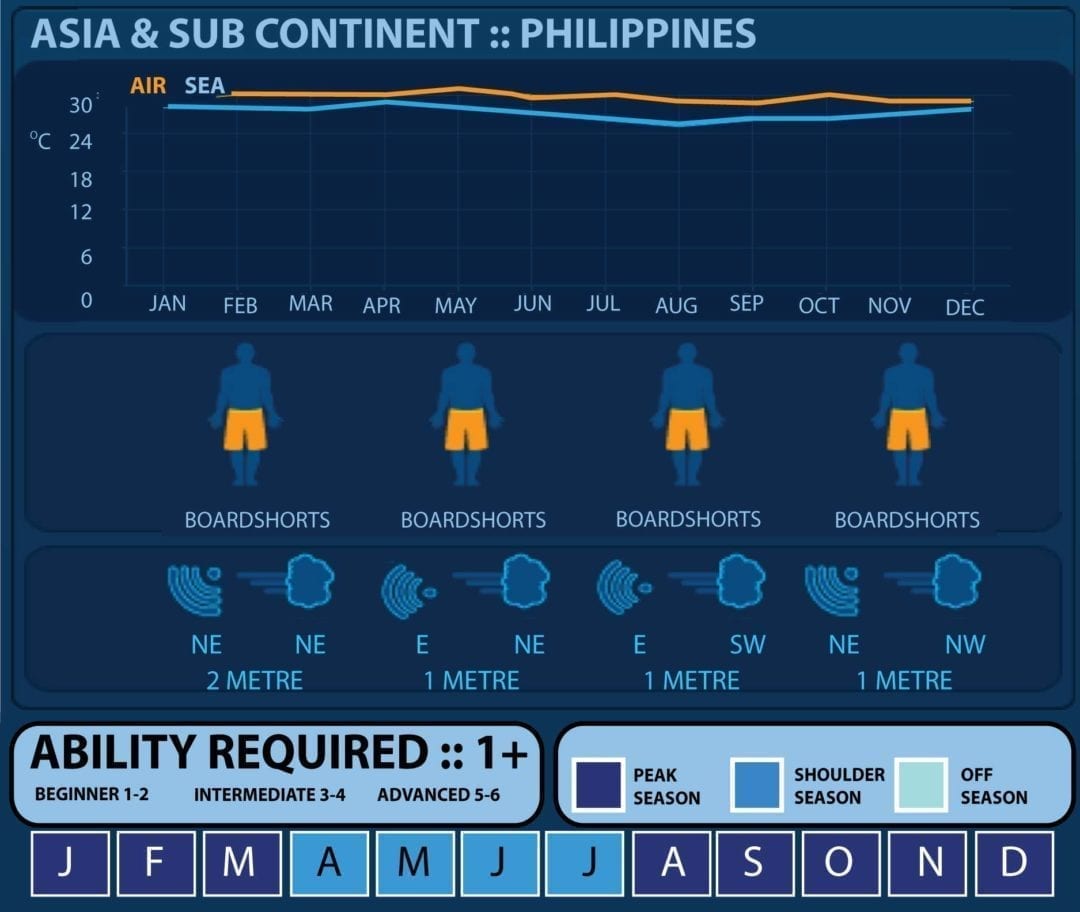
Generally, the best months for surf in the Philippines are August through to November. This is the best time for typhoon swells and also comes with the best winds for the quality surf breaks. Swell starts to pick up in July and August with offshore winds on the Pacific Coast, Typhoons then start to form in the Western Pacific. If you’re looking for big swell coming out of the heavy monsoon season in the Pacific then get out there in September and pray for typhoons. From June to November, despite the Typhoons & monsoons, the east remains dry and warm as this weather dominates the west coast 'wet season' around Luzon. The typhoon season slows down around November with little swell arriving on the east coast. At this point of the year it’s time to start looking at the west coast and the South China Sea. There are waves to be had off of Luzon Island and in Palawan. February sees the northeast monsoon relaxing and the tropical heat sets in from March through until May. Unless you see tropical storms on the charts then don’t expect swell to grow to anything over knee high.
Surf Safety in the Philippines
Many of the Philippines’ best waves break over shallow coral reef and need typhoon swell to come alive, so plan around your ability, the tide and the conditions on the day.
Know your level: unless mentioned, Philippines surf breaks are generally for intermediate surfers and above. The exception is low season, when all breaks are surfable by beginners.
Respect the reef: Cloud 9 is a short, powerful barrel over shallow live coral, and several other top breaks, such as San Juan, are reef breaks.
Watch the tide: Cloud 9 is best at mid to high tide, and Stimpy’s works best on mid tide with clean winds.
Expect crowds at the easier waves: the mellower spots around Cloud 9, such as Jacking Horse, suit beginners but are much busier.
Come prepared: away from Siargao, surf shops and even basic infrastructure are few and far between.
Check travel advice: rebels in the Mindanao region sometimes create conflict, so check your country’s travel warnings before you go.

Philippines travel attractions
When you aren’t surfing, the Philippines has a plethora of activities to keep you active. Sun and sand are the name of the game in this island nation. With some of the best white sand beaches in the world, a beach day should be on every visitor’s itinerary. Island hopping tours (both boozy and family-friendly) are a great option for enjoying uninhabited islands. Other water sports include sea kayaking and windsurfing. Visitors can also hike the Taal Volcano, gape at gorgeous rice terraces in Banaue, tour historical churches or seek out rare wildlife such as the gremlin-like tarsier. Of course, an evening spent eating delicious Filipino BBQ and watching the sun sink into the water while dreaming of tomorrow's surf is also a worthy option. On Siargao you can explore mangrove forests by paddleboard or boat, visit hidden lagoons and quiet islands, or take a day trip to Magpupungko Rock Pools, Burgos and Alegria Beach.
About the Philippines
The Philippines is in Southeast Asia, just across the South China Sea from Hong Kong and south of Taiwan. After being occupied by Spain, the United States and Japan, the Philippines gained independence in 1946. Today the island nation enjoys relative stability, although rebels in the Mindanao region sometimes create conflict, so be sure to check your country’s travel warnings before heading to the region. With only 2,000 of its 7,107 islands inhabited, the country offers both tourist hotspots and deserted destinations, and accommodation ranges from ultra-luxurious dive resorts to budget bungalows.
Getting to the Philippines and Siargao
Ninoy Aquino International Airport (MNL, Manila), Clark International Airport (CRK), Mactan-Cebu International Airport (CEB, Cebu) and Kalibo International Airport (KLO, Boracay) are all well connected by international flights from Australia, Europe and North America. Once in the country, you can use local ferries to get around, and Cebu Pacific and AirAsia offer low-cost inter-island flights. Siargao is served by Sayak Airport (IAO), and stays at Nay Palad Hideaway include private return transfers between the airport and the resort.
Travel Information
Time Zone
UTC+08:00
Currency
PHP
Calling code
+63
Electric
220V – Plug A, B, C
Philippines Surf FAQs
Quick answers on Siargao surfing, Cloud 9, the surf season and planning your trip. Tap a question to open it.
The best-known waves are on Siargao: Cloud 9, a short, powerful barrelling right over shallow live coral; Jacking Horse, a mellow, rolling peak beside Cloud 9 that’s perfect for longboards and beginners; Rock Island, a fast, hollow right-hand point; and Stimpy’s, a hollow, fast left-hand point. Elsewhere, Bagasbas is a gentle beach break suitable for beginners, Aparri has lefts and rights off the pier for beginners to pros, San Juan is a powerful, hollow right-hand beach and reef break, and Charlie’s Point near Baler is a wedgy break over sand and gravel. Unless mentioned, most Philippines breaks are for intermediate surfers and above. See our best surf breaks.
Generally August to November. Swell starts to pick up in July and August with offshore winds on the Pacific coast, then typhoons form in the Western Pacific, and September is the month to go for big typhoon swell. The typhoon season slows down around November, when it’s time to look at the west coast and the South China Sea, with waves off Luzon and in Palawan. From March to May, unless there are tropical storms on the charts, don’t expect the swell to grow much past knee high.
Siargao looks out to the Pacific, and the best months are generally August to November, when typhoon swells arrive and the Pacific coast gets offshore winds. Cloud 9 is best at mid to high tide. Outside that window the waves are smaller, and low season is when beginners can surf breaks that are usually for intermediate surfers and above.
Cloud 9 on Siargao is a powerful right that breaks straight out of deep water and focuses its energy at the beach: a short but perfect barrelling peak over shallow live coral, which also breaks left. On its day it has been voted one of the five best waves in the world. It’s best at mid to high tide and suits intermediate surfers and above; the mellower spots nearby suit beginners but are much busier.
There are more than 20 surf breaks around Siargao, from playful walls to heavy reef barrels. As well as Cloud 9, they include Jacking Horse, a mellow, rolling peak right beside it that’s perfect for longboards and beginners; Quicksilver, a playful right-hander just north of Cloud 9 that’s ideal for intermediates; and Rock Island and Stimpy’s, which are reached by boat.
Yes, if you choose the right spot and season. Bagasbas is a gentle beach break suitable for beginners, and Aparri suits beginners to pros. Most other breaks are for intermediate surfers and above, except in low season, when all breaks are surfable by beginners. On Siargao, Jacking Horse, a mellow, rolling peak beside Cloud 9, is perfect for beginners and longboards, but the mellower spots around Cloud 9 are much busier.
Yes. Stays at Nay Palad Hideaway include professional surf coaching.
Many breaks need typhoon swell from the Western Pacific to truly come alive. Rock Island starts working at 3ft and gets up to 12ft, Stimpy’s is 6–10ft and Aparri gets 3–6ft. From March to May, without tropical storms, expect little more than knee-high waves.
The main international gateways are Ninoy Aquino International Airport (MNL, Manila), Clark International Airport (CRK), Mactan-Cebu International Airport (CEB, Cebu) and Kalibo International Airport (KLO, Boracay), with flights from Australia, Europe and North America. Cebu Pacific and AirAsia offer low-cost inter-island flights, and local ferries are an option for getting around. Siargao is served by Sayak Airport (IAO), and stays at Nay Palad Hideaway include private return transfers between the airport and the resort.
On Siargao, Nay Palad Hideaway is an all-inclusive, ultra-luxury surf resort on the island’s southeastern tip, with Cloud 9 a short drive away. Across the country, accommodation ranges from ultra-luxurious dive resorts to budget bungalows.
Plenty: white-sand beaches, island hopping, sea kayaking and windsurfing, hiking Taal Volcano, the rice terraces of Banaue, historical churches and rare wildlife such as the tarsier. On Siargao you can explore mangrove forests by paddleboard or boat, visit hidden lagoons and quiet islands, or take a day trip to Magpupungko Rock Pools, Burgos and Alegria Beach.
The currency is the Philippine peso (PHP), the time zone is UTC+08:00, the calling code is +63 and the power supply is 220V with plug types A, B and C. Away from the surf hub of Siargao, surf shops and even basic infrastructure are few and far between, so come prepared, and check your country’s travel warnings before you go.
Many of the best waves break over shallow live coral and are for intermediate surfers and above, so choose breaks that match your ability and time your sessions around the tide (Cloud 9 is best at mid to high tide). The Philippines enjoys relative stability, although rebels in the Mindanao region sometimes create conflict, so check your country’s travel warnings before heading there. See our surf safety tips.
 Philippines surf holidays
Ultra luxury surf retreat in Siargao with handcrafted villas, Cloud 9 access, world‑class dining, and unforgettable island experiences.
Luxury surf retreat in Siargao with handcrafted villas, Cloud 9 nearby, amazing dining.
Enquire
Disclaimer - The trip booked is operated by independent operator(s) and is not part of or in partnership with Perfect Wave Travel. Perfect Wave Travel acts as an agent only. We sell various travel related products on behalf of numerous transport, accommodation and other service providers, such as airlines, land based accommodation and boat charter operators. Perfect Wave Travel obligation is to make travel bookings on your behalf and to arrange relevant contracts between you and travel service providers. Perfect Wave Travel has no responsibility for these services nor do we make or give any warranty of representation regarding their standards. All bookings are made subject to the terms and conditions and limitations of liability imposed by these service providers.
Terms and Conditions - All bookings are subject to Terms & Conditions. By submitting this booking form you have confirmed that you accept and will be bound by these terms.


Award Winning
World Class
Customer Service

Global Company
Multiple Locations
Around The World

Traveller Care Guarantee
24/7 Worldwide
Emergency Support
Perfection Pass
The World's First
Surfer Loyalty Program
Best Price Guarantee
Find A Price Cheaper
And We'll Match It!
Real Surfers.
Real Advice.
Find A Price Cheaper
And We'll Match It!
Travel With Purpose
Find A Price Cheaper
And We'll Match It!